00 · 01
Chinese AI models capture 85% of token volume with low spend share
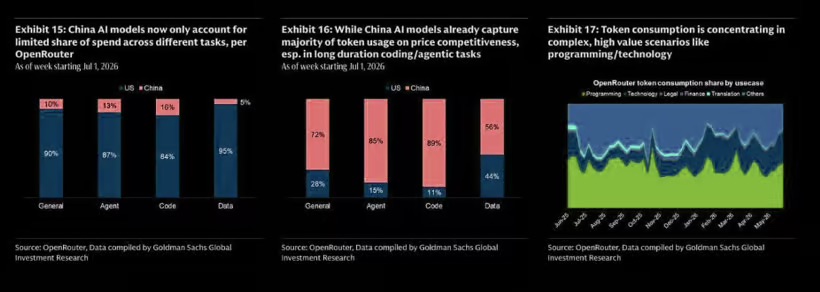
According to OpenRouter data compiled by Goldman Sachs, Chinese AI models now account for 85–89% of global token usage in programming and agentic workflows. However, due to aggressive price competitiveness, they capture only 10–16% of total dollar spend.
Distribution is expanding rapidly: Alibaba's Qwen surpassed 3 billion downloads over the past six months, exceeding Meta and Google combined. Chinese providers are prioritizing market share and ecosystem volume ahead of direct monetization.
01 · 02
Chinese AI models lead coding rankings at fractional prices
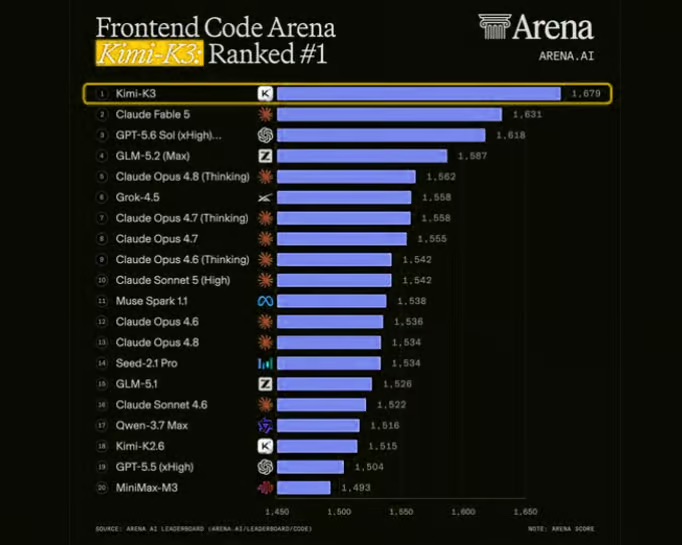
Chinese open-weight AI models are competing at the very top of performance leaderboards: Kimi-K3 currently ranks first in Arena's Frontend Code benchmark, outperforming leading models from Anthropic, OpenAI, and Meta.
Despite comparable performance, top Chinese models cost around $0.20–$2.30 per million tokens versus $4–$8 for US peers. After securing volume share, providers are beginning to lift prices: Zhipu has increased rates by ~110% year-to-date while targeting $1 billion in ARR by year-end.
02 · 03
China closes AI chip gap as US faces energy constraints
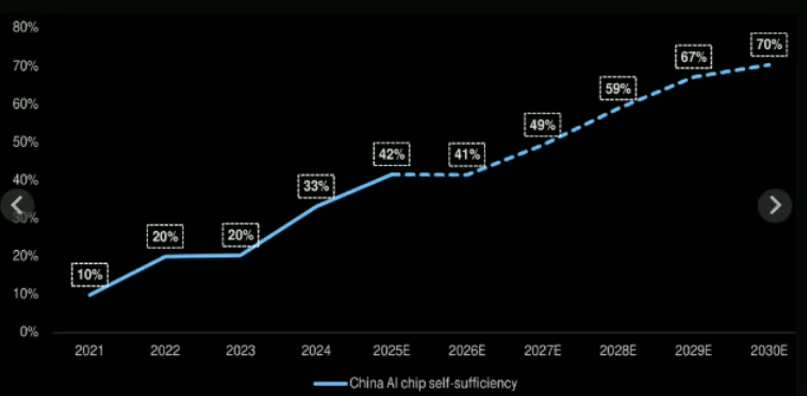
The thesis that chip export bans would halt Chinese AI development is losing steam: Meituan's LongCat 2.0 was trained end-to-end on 50,000 Huawei Atlas 950 chips. Goldman Sachs projects China's AI chip self-sufficiency will rise from 41% today to 70% by 2030.
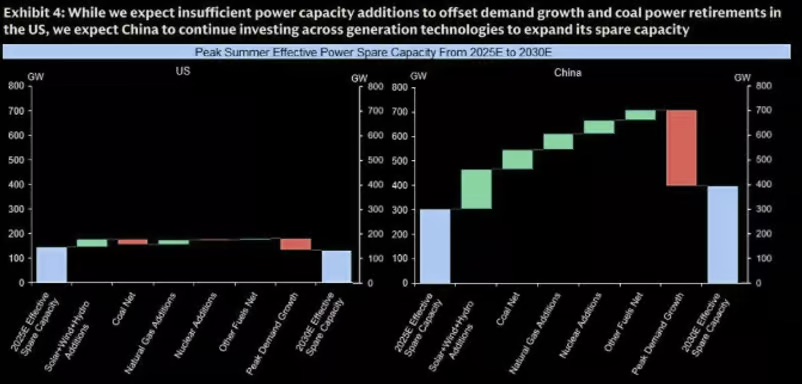
Meanwhile, structural bottlenecks are shifting to electricity supply. Goldman forecasts US spare power capacity shrinking toward 130GW by 2030, while China's expands toward 400GW. The hardware gap is narrowing, while the power generation advantage swings toward China.
03 · 04
A capex cycle with a sovereign backstop in China
Beijing increasingly treats computing power as strategic infrastructure: its five-year plan targets over RMB 35 trillion in capital expenditures alongside an 80% domestic hardware mandate.
The defining difference lies in who underwrites the cycle. While US AI cloud economics depend heavily on private capital access and near-term corporate ROI, Chinese infrastructure expansion enjoys explicit sovereign backing. This creates a fundamentally different downside risk profile between the two markets.
04 · 05
Massive valuation gap between US and China AI compute providers
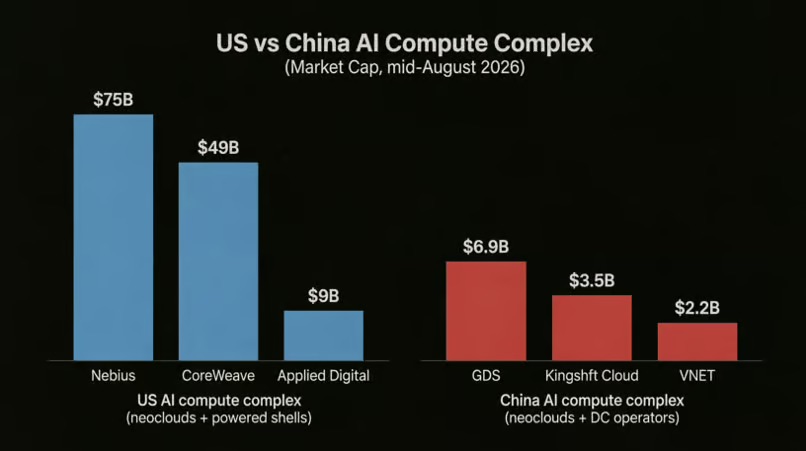
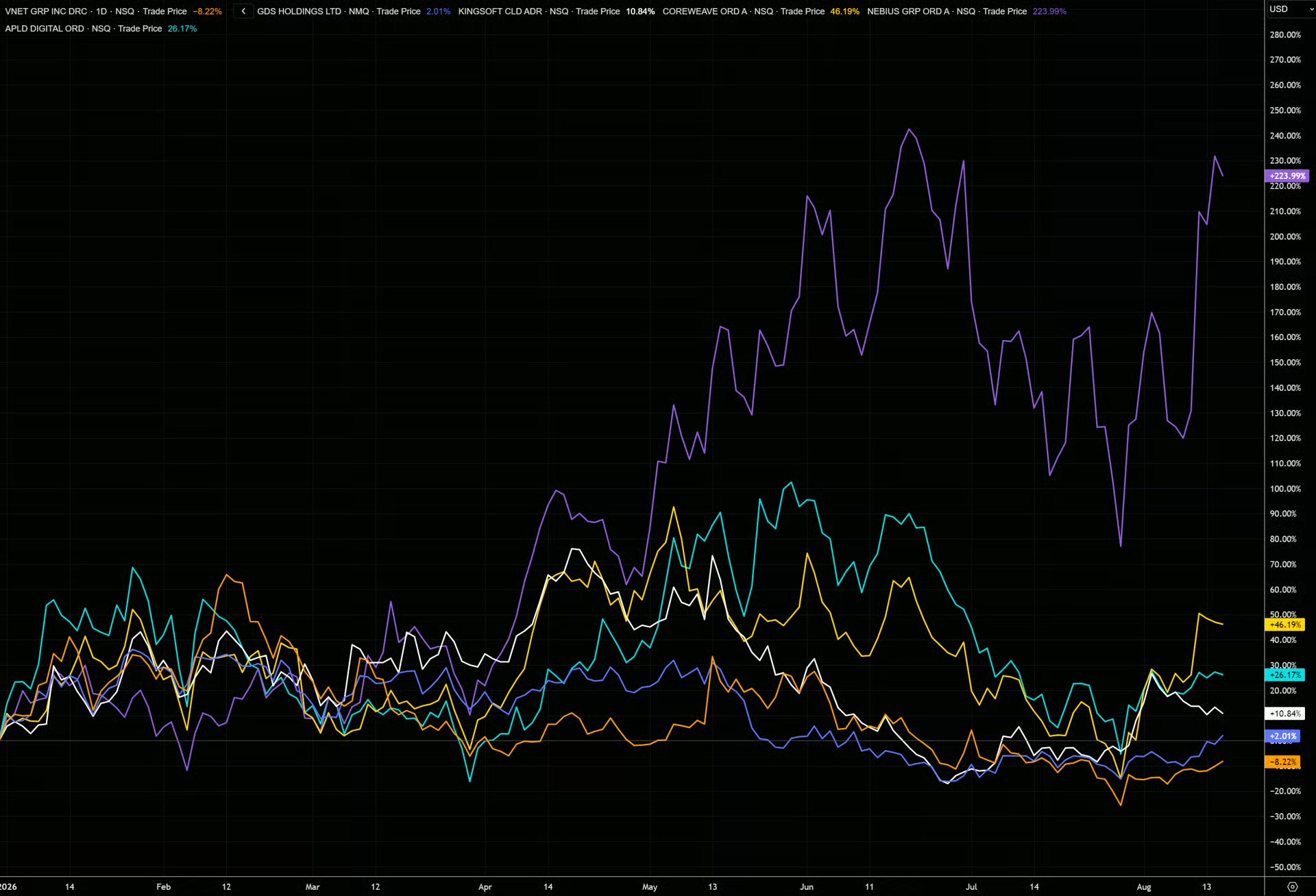
The market displays an extreme valuation disparity between US and Chinese AI compute infrastructure players. US neocloud providers (Nebius, CoreWeave, Applied Digital) trade at $9B–$75B in market cap, whereas their Chinese counterparts (GDS, Kingsoft Cloud, VNET) sit between $2B and $7B.
CoreWeave alone ($49B) could buy the entire Chinese trio ($12.6B combined) nearly four times over. The revenue comparison underscores the distortion: Applied Digital, generating a few hundred million dollars in sales, is valued higher than GDS, which guides to $1.7B in revenue. Despite participating in the same global AI expansion, they trade at vastly different price tags.
05 · 06
China AI infrastructure layer delivers fundamental inflection
A stark valuation disparity exists across China's AI ecosystem: investors pay ~177x recurring revenue for model labs like Zhipu, while the core infrastructure hosting them (Alibaba, Tencent) trades at just 15–17x P/E. Every incremental token must run on physical infrastructure, giving the hosting layer steady recurring demand.
Crucially, low valuations are now backed by fundamental improvements. Data center operator GDS reported record H1 bookings of 470MW, secured another 600MW in reservations, raised forward guidance, and returned to profitability. Tangible operational growth serves as a catalyst for sector re-rating.
06 · 07
Key downside risks to the China AI infrastructure thesis
Several distinct developments could invalidate the bullish thesis on Chinese compute infrastructure: a sharp loss of token market share in Chinese open-weight models, failure of domestic chips to match foreign cost efficiency, or a slowdown in new bookings at data center operators (GDS, VNET) for two consecutive quarters.
Currently, none of these negative signals are materializing; in fact, the first three metrics continue to strengthen. The primary unresolved threat remains geopolitical tension, an unpredictable factor that cannot be modeled and could trigger a broader de-rating of Chinese assets.
07 · 08
Global exposure to China hits lows, setting base for re-rating
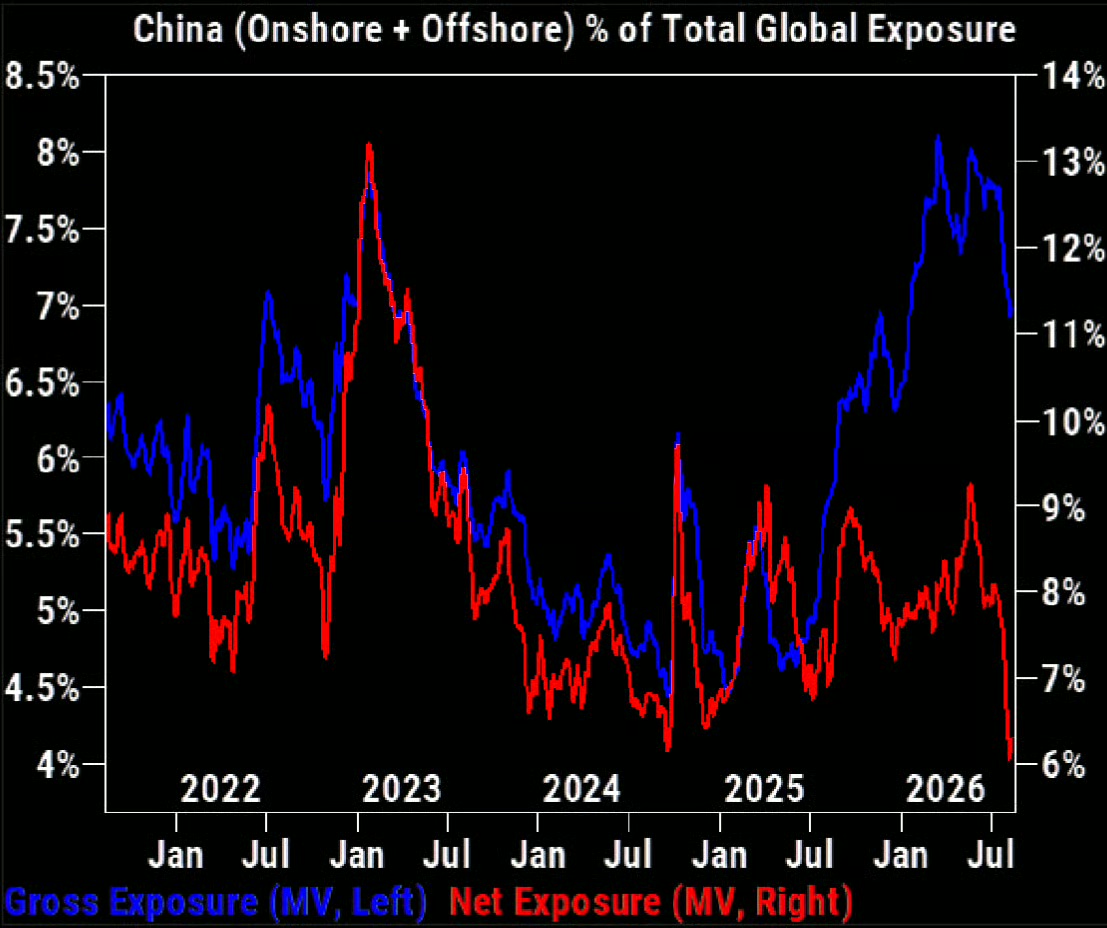
According to Goldman Sachs prime brokerage data, net institutional exposure to Chinese equities (onshore and offshore) has dropped toward multi-year lows, falling near 6% of total global exposure.
While light positioning is not the core investment thesis on its own, it significantly improves the market setup. Unlike the crowded US tech trade, any fundamental re-rating of Chinese AI infrastructure would launch from extremely depressed institutional ownership levels.
08 · 09
Investment basket for the China AI infrastructure theme
Investors targeting the growth of Chinese compute infrastructure focus on three primary data center operators: GDS offers proven quality and strong booking visibility, VNET provides deep value ahead of its August 18 earnings catalyst, and Kingsoft Cloud delivers the highest elasticity to surging model-lab rental demand.
For a more defensive allocation, mega-caps Alibaba and Tencent trade at conservative 15–17x P/E multiples. They host diverse AI labs across their cloud platforms, monetizing rising computing demand regardless of which specific model wins the race.
For an in-depth macro-structure trend breakdown of these assets, see the "Asset analysis" section.
We've already mapped entries on the tickers in this report.
Levels, stops, and targets live inside the members area and Telegram — pushed the moment a setup triggers. Start a 14-day trial and get access before we open the first position in this theme. No card required.