
01
What exactly happened?
According to preliminary data, the breach did not start with cracking wallet passwords, but with the compromise of a work laptop belonging to one of the exchange's DevOps engineers. Through it, the attacker gained access to an internal service and was able to send withdrawal transactions from Binance's main hot wallets (on Ethereum, Arbitrum, Optimism and Avalanche).
What was the trick behind the theft itself? Normally, every coin has to be withdrawn from a crypto wallet as a separate transfer. If the hacker had started moving 30 different tokens one by one, the exchange's security would have noticed and cut off access within the first minute.
But the attacker used a recent Ethereum feature (EIP-7702). In essence, it is a one-click general power of attorney. He made the compromised exchange server sign a single authorization that handed wallet control over to his bot program. And that bot, in one batch within seconds, swept dozens of different coins worth billions of dollars off the wallet.
02
Billions frozen and a brilliantly designed Aave trick
Most of the stolen funds were stablecoins (USDT, USDC and RLUSD). For the hacker, these coins are a burning asset: the issuing companies have a technical kill switch that can remotely freeze tokens on any wallet in one click. Pure ether (ETH), on the other hand, cannot be blocked by anyone.
Understanding that he had only a few dozen minutes before the freeze, the hacker moved in two directions:
- Panic buying of ether. He started pouring hundreds of millions of USDT into exchanges (Uniswap), buying up all available ETH. Volumes like that pushed the price of ether on decentralized exchanges to $2,560-3,000 in the moment, against a market price of around $2,280. Regular arbitrage traders immediately took advantage of the gap: they bought cheap ether elsewhere and sold it into the panicking hacker's orders (one such wallet made $3.47 million off the hacker in an hour).
- An inventive workaround through borrowing. This was a brilliant move, executed with a jeweler's precision. Hackers usually just try to dump stolen coins into the order book, losing huge sums to price swings. This one used the lending protocol Aave as a one-way ATM. The protocol's smart contract is simply a robot: it does not read the news and does not know the money was just stolen. The hacker deposited the burning USDT as collateral and, at a clean market rate with no exchange losses, borrowed pure ether (WETH) against it, which nobody can freeze, and simply walked away, leaving the protocol to deal with the tainted collateral.
Social media claims he pulled off one and a half billion this way, but in reality he only managed to put $60M USDT into Aave and take out about $44.6 million in ether. Aave itself was not harmed: the collateral inside it is not frozen, and the position will close normally without losses for depositors.
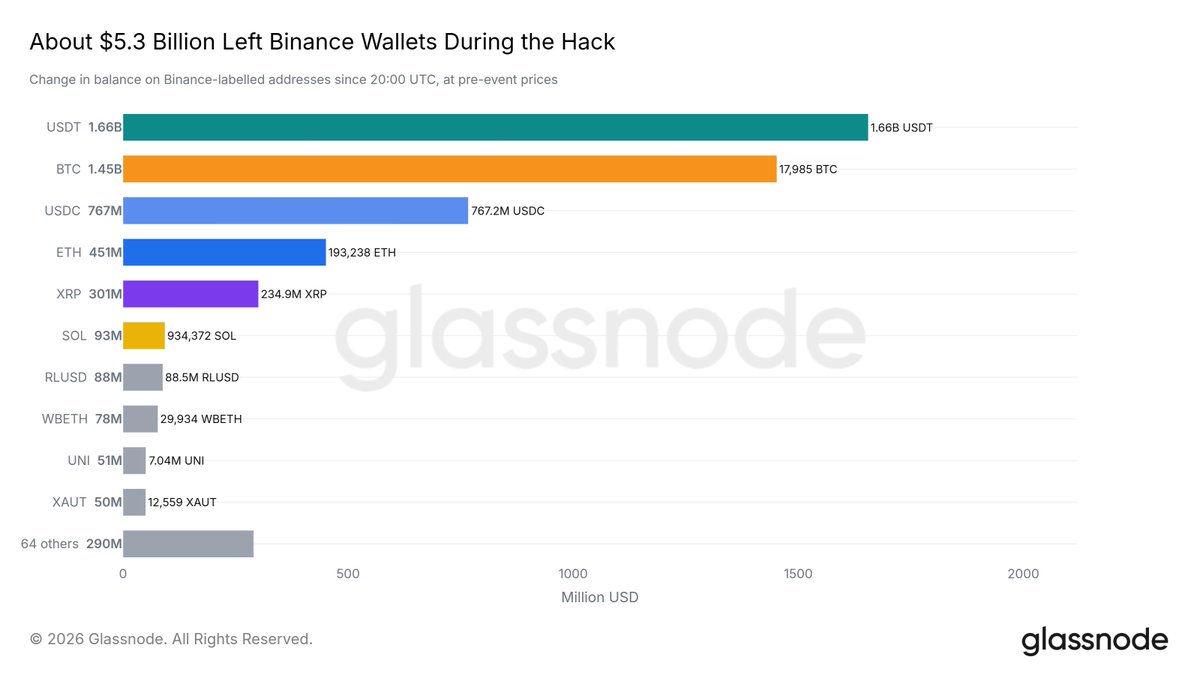
03
What is happening right now?
The market's reaction was lightning fast: key players teamed up within the first hour after the attack:
- About $3 billion frozen. Tether (over $1.56 billion in USDT), Circle (over $800 million in USDC) and Ripple (~$200 million in RLUSD) froze the hacker's wallets. That money turned into useless paper: the hacker will never be able to use it again.
- What does the hacker still have? His 55+ wallets now hold pure ether (about 197,460 ETH, roughly $436 million), about $45 million in WETH borrowed from Aave, and a set of 15+ different altcoins worth another $120-160 million. In total, around $600 million, which analysts (Arkham, ZachXBT) and law enforcement are tracking in real time, flagging every cent with a black mark.
- DeFi defense. Aave has temporarily paused opening new loans on most markets so that the hacker cannot post the stolen altcoins as collateral (withdrawals for regular users keep working).
- Binance's position. The exchange has already fixed the vulnerability. Co-founder Yi He officially stated that the exchange will fully cover all losses from its own SAFU reserve fund and that user funds are safe.
04
What should regular users do?
1. Don't panic. Only the exchange's operational (hot) wallets were hit; the bulk of funds sits in cold storage. Binance has enough reserves and profit to close the gap after the bulk of the stolen stablecoins was frozen.
2. Don't rush to withdraw funds through questionable workarounds. Wait for withdrawals on the exchange itself to be fully back to normal operation.
(!) 3. Maximum phishing protection, this is the main threat right now! Against the backdrop of loud news, scammers have already launched thousands of fake newsletters, bots and "support" accounts. Never follow links offering to check your account security, revoke the hacker's access, or claim compensation from Binance. This is exactly how people are losing real money right now.
4. Be careful with leverage. While the hacker tries to sell his remaining altcoins (LINK, UNI, AAVE, ONDO, AVAX and others) through decentralized exchanges, individual coins may see sharp local price spikes.
The situation is under control. We are watching for the official report and the updated proof-of-reserves audit from the exchange. Take care of your wallets and verify your information! 🤝
05
How did the market react and what to expect next? 📈
It is curious how often major news events arrive exactly when the chart is already fully set up for the move.
Just yesterday, before any news of the hack, our review took a detailed look at the market's technical structure and warned about the high probability of another wave down. Overnight, against the backdrop of the Binance panic, that scenario played out in full, and prices landed right in the areas we had mapped out.
The main question for the market now is how buyers act at current levels. If key assets hold inside the target support zones and do not settle below them, this emotional flush will serve as an excellent reset before the uptrend resumes.
For the detailed chart breakdown, the exact support zone boundaries and our expectations for key assets, see yesterday's open weekly report: https://belfed.com/research/2026-10-29-1/

We've already mapped entries on the tickers in this report.
Levels, stops, and targets live inside the members area and Telegram, pushed the moment a setup triggers. Start a 14-day trial and get access before we open the first position in this theme. No card required.